


The Founding of Microbus
Microbus Electronic Service AB was founded on November 2, 1983. Starting a limited company in the 1980s was a considerably more complicated process compared to today, when the Swedish Companies Registration Office operates online.
In the 1980s, it was common practice to hire a law firm specialized in establishing companies. When Microbus was “born,” one of our first tasks was to name the company. The pre-packaged company initially carried the name “Grundstenen 16.169,” created by Svenska Standardbolag AB on October 11, 1983.
After the acquisition and activation of the company, it received its final name on November 2, 1983: Microbus Electronic Service AB.
The idea behind Microbus was to develop, sell, and service industrial electronic products. The company was intended to operate throughout southern Sweden, with three offices located in Malmö, Ljungby, and Jönköping.
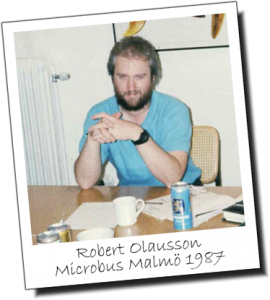
Microbus was founded by five individuals: Ingemar Nybin, Mats Lindholm, Robert Olausson, Tommy Fristedt, and Bertil Nilsson. All except Bertil Nilsson were employed by the company from the beginning.


Starting a company simultaneously in three locations was not an easy task. The first six months consisted largely of preparatory work and negotiations. In March 1984, this resulted in Per Mauritzon joining as a passive shareholder, while Bertil left the company. For a period before Bertil transferred his shares, there were six shareholders. All formalities were resolved relatively quickly, and on June 4, 1984, all essential documentation with authorities, banks, and other institutions was finalized. However, the printed share certificates mistakenly carried Bertil’s name instead of Per’s.
Microbus was now equally owned by Ingemar, Mats, Robert, Tommy, and Per. Since the company had not yet begun active operations during the summer of 1984, Per Mauritzon is also considered one of the founders. The company’s shares were equally distributed among the founders.
Early Operations
Initially, Microbus worked with third-party service contracts to build equity capital. Sales exceeded expectations — business was good.
The capital surplus was invested in developing proprietary products. Among the products serviced were electronic scales, printers, and cash registers for retail.
In the mid-1980s, Microbus partners and customers included Svea Band, Atronic, KF Solidar, Kontorsdata Service, Bowlingservice AB, Mekaniaverken, Beijer Industri, and Elektrix. Only a few years after its founding, Microbus had developed several in-house products. Sales of proprietary products increased from 0% in 1983 to 30% of total revenue in 1986.

Acquisition of Elektrix

In 1986, one of Microbus’ partners, Elektrix, encountered financial difficulties. Despite having several large orders, the company lacked liquidity. A capital injection was required to complete necessary purchases and fulfill deliveries.
At the end of 1985, Microbus acquired Elektrix. At the time of acquisition, Microbus’ future CEO, Jan Niskala, was working as a contracted technician at Elektrix.
Following the acquisition, Jan accepted a position at Microbus as Production Manager and Programmer/Developer. Elektrix founder Leif Rix also joined Microbus as Development Manager. Leif was a skilled entrepreneur, innovator, and designer.
At Elektrix, Leif had developed an LED display board with 77 mm high characters. His father owned a bowling alley in Arlöv, where Leif tested a newly developed bowling scoreboard using LED display boards. At Microbus, Leif began developing a larger 165 mm character display intended for a large swimming scoreboard previously sold by Microbus.
Leif, accustomed to working independently, found it challenging to work within a team and decided to leave after six months. The technical know-how required for manufacturing and further development of the acquired products remained within Microbus through Jan. Tommy assumed responsibility for some of Leif’s projects, while Jan continued development of the 165 mm displays and associated control boards.

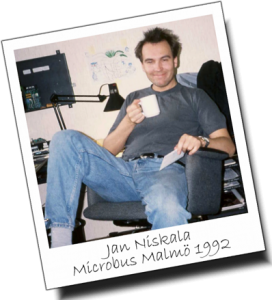
The Elektrix acquisition provided Microbus with product lines that were fundamentally strong but had been poorly managed in terms of customers and technology. Microbus invested development and sales resources primarily into bowling scoreboards, identified as having strong potential. The deficiencies were quickly corrected, and sales accelerated. Two years later, bowling scoreboards accounted for one-third of the Malmö office’s revenue. That same year, Jan became a shareholder in Microbus.
The company’s 1,200 shares were now owned equally by six shareholders: Ingemar, Mats, Per, Robert, Tommy, and Jan.
Early Proprietary Products
One of Microbus’ early proprietary products was the MIDS Meter, designed by Tommy and adapted to Leif’s LED display. MIDS stands for Microbus Industrial Display System. It was a measuring instrument with large characters that could connect directly to a wide range of industrial standard sensors.
Another product developed during this period was Dialmatic, originally designed by Leif Rix. It could perform call forwarding between telephone numbers — functionality that the national telecommunications authority (Televerket) at the time could not provide.
Headquarters in Malmö
At the Malmö headquarters, three of the shareholders were employed. All administrative tasks were handled from Malmö. The Ljungby and Jönköping offices submitted invoicing documentation to Malmö and paid cost-based administrative fees.
In 1985, the Malmö office relocated from Testvägen in Arlöv to Östra Kristinelundsvägen in Malmö.
Ljungby Office Growth
Robert initially worked alone at the Ljungby office. Over time, Per Mauritzon became increasingly involved and began working full-time at Microbus in 1987.
Jönköping Office
Tommy managed the Jönköping office independently. Eventually, he found it demanding to operate alone while headquarters remained in Malmö. He received an offer to work as a developer for a Microbus customer in the United States and accepted.
Following Tommy’s departure, the Jönköping office was closed. His shares were distributed equally among the remaining owners. Microbus was now equally owned by Ingemar, Mats, Robert, Per, and Jan.

First Mobile Phone
Microbus’ first mobile phone was a Mitsubishi Pocket Model P-08S/6U05, manufactured in Japan in 1987. It weighed 540 grams, had one hour of talk time and eight hours of standby time, and operated on the NMT network. The antenna had to be extended manually to make or receive calls.
In 1987, Microbus purchased four units for SEK 86,000 plus VAT.

One of the Founders at the Head Office Leaves

In the autumn of 1989, Mats decided to leave Microbus to pursue other opportunities. Determining how his shares should be valued and distributed proved to be a difficult issue to resolve. Mats remained a shareholder for several years until negotiations with the Ljungby office and Björn’s entry were finalized. When Mats left, Jan was called into military service, making the situation particularly challenging for Ingemar, who for several months worked alone at the Microbus Malmö office.
Jan returned to Microbus with renewed energy and ideas. Together with Ingemar, he decided to hire Björn, whom Jan had met during his military service. After various discussions and negotiations with the Ljungby office, it was ultimately decided a year later that Björn would take over Mats’ shareholding.
Microbus Cuts Ties with the Ljungby Office
When the company was founded in 1983, being geographically distributed was a significant advantage. It enabled Microbus to secure third-party service contracts covering the entire southern region of Sweden.
By 1990, however, the situation had changed. The Malmö office generated 90% of its revenue from proprietary products or local service assignments. The Ljungby office worked exclusively with local companies.
Both offices sought a solution in which Microbus would be divided into two legally separate companies. After a year of discussions and negotiations, an agreement was reached at a meeting in Stidsvig on December 16, 1992.
The Ljungby office would establish a new limited company named Microbus Ljungby AB. Microbus Electronic Service AB granted Microbus Ljungby the right to use the name Microbus and the same logotype. A financial settlement between the companies and shareholders was completed.
After the transaction, Microbus Electronic Service AB was owned by three individuals: Ingemar, Jan, and Björn, each holding 400 shares. Microbus Ljungby AB was owned equally by Robert and Per. Ingemar was now the last remaining shareholder among the original six founders. Around the same time, Microbus relocated from its office premises to a more suitable industrial facility near Ystadvägen in Malmö.

Jan Niskala Appointed CEO
Ingemar’s natural role in the company had always been in sales. Since the beginning, Jan’s role had been that of the unifying diplomat and driving force within the company. It was therefore a simple and natural agreement, made in the kitchen at Microbus’ premises on December 6, 2001, that Jan would assume the official title of CEO from Ingemar. At the same time, Microbus expanded its existing premises by incorporating adjacent space, thereby increasing its office area.
The Last Founder Leaves

After many years of working together, both Björn and Ingemar began considering new opportunities, independently and without knowing the other’s thoughts. Ingemar decided first. Knowing that his strengths lay in sales, he proposed selling his entire shareholding while continuing to work as an employed salesperson for Microbus. Various solutions were considered.
When Ingemar received an offer from another company, the natural solution became that he would continue selling Microbus products through the new company. Ingemar sold his entire shareholding and, during a one-year transition period, continued selling Microbus products on a commission basis.
Since Björn was also considering selling his shares, Jan purchased Ingemar’s stake. After Ingemar left, Björn’s responsibilities changed positively, and he chose to remain with the company.
Following the transaction, Jan owned 800 shares and Björn 400 of the company’s 1,200 shares. One month after Jan’s purchase of Ingemar’s shares, Jan proposed equalizing ownership and offered Björn the opportunity to buy 199 shares for SEK 1. Björn declined. Several years later, Björn reconsidered and sought a 50/50 ownership structure, offering to purchase shares at market value. However, due to strong company growth, determining market value proved difficult. Ownership therefore remained unchanged, though an agreement was reached to divide salaries and benefits equally between the two owners. The company performed well, and both were satisfied with the arrangement.
Microbus – A New Beginning in 2004
After Ingemar left the board, the company shifted strategy and focused on growth. With Björn and Jan leading the board, momentum increased significantly. A new expansion plan was implemented, including new premises, a new phone number, new hires, and the development of a completely new catalog and website.
Within a short time, Microbus sold several major systems to companies such as Scania, resulting in increased demand for engineers. Microbus both recruited new employees and hired temporary staff through staffing agencies. Two years after Ingemar’s departure, revenue had tripled. The company, which previously had only one employed technician (besides the owners), began expanding its workforce.

New Larger Premises
Microbus relocated to larger premises on Hantverkaregatan in Arlöv. The new facilities provided expanded office space and a conference room. The workshop was significantly larger, with a convenient loading bay. Microbus invested in a new telephone exchange and computer system. A few years later, Microbus opened a new office in Varberg.
The image below shows the staff of Microbus Electronic Service AB in 2007.

Offices in Malmö, Gothenburg, and Stockholm
During the following ten years (2007–2017), Microbus opened additional offices in Gothenburg, Stockholm, and Shenzhen, China. The Varberg office became an independent entity focused on LED lighting for industrial and public environments.
The Malmö headquarters underwent several expansions, including increased floor space and workshop renovations. A new showroom, new conference room, and a high-bay section equipped with overhead crane and installation aids were added to facilitate the assembly and production of large outdoor displays.
Options Program
During the recession of 2009/2010, Jan decided to grant stock options of 50 shares each, with a three-year term at a favorable price, to two key individuals in the organization: Andreas Lagerberg and Robert Harnisch. Three years later, on January 1, 2013, Andreas and Robert exercised their options. At the same time, Jan transferred 50 of his shares to Björn for a symbolic amount.
The company’s 1,200 shares were then distributed as follows:
- Jan: 650 shares
- Björn: 450 shares
- Andreas: 50 shares
- Robert: 50 shares
After several years and various discussions, Robert decided to sell his shares to Andreas (both Jan and Björn waived their pre-emptive rights).
New Financial Governance – Increased Profit Margin

In spring 2018, on his 50th birthday, Björn Jönsson decided to leave the company and sell his shares — a difficult but necessary decision. He had gradually reduced his role in management in prior years and had faced personal challenges. During periods of absence in 2017, his responsibilities as CFO and Head of Purchasing were handled by replacement staff.
Björn authorized his lawyer to manage the share transaction. Through legal representation, his ownership in Microbus and two other companies was dissolved. Microbus released Björn from his personal guarantees and repurchased his 450 shares.
Microbus thanks Björn for his many years of dedication. He played an important role in building the company during its early years.
When a company repurchases its own shares, those shares are removed from the market. The remaining shareholders retained their number of shares, while the total number of shares decreased from 1,200 to 750.
After the repurchase, the 750 shares were distributed as follows:
- Jan Niskala: 650 shares (86.66%)
- Andreas Lagerberg: 100 shares (13.33%)
With a new Head of Purchasing and stronger financial governance, revenue increased from SEK 20 million (2017) to SEK 34 million (2019). During the same period, profits increased by more than 750%.